Things · Personal tools and making
Changelog
An iPhone app for getting notes into Release Notes in two taps, with photos, voice memos, places, Upcoming dates, Siri, and widgets. Jamie’s first iPhone app.
What changed today? Commit.
On this pageJump
Changelog is an iPhone app for getting notes into Release Notes, the daily Your Version Number email. It is not a second Release Notes: reading, searching, and looking back stay on the web, and Changelog is for getting things in. You write a line, tap a tag, and Commit, and it is in today’s notes. A note can carry photos, a voice memo, or where you are, and Siri, the Action Button, a widget, or the share sheet can start one. Your Upcoming dates, and the activity log from every channel, are a tab away.
Jamie built it with coding agents in a single day, starting on the morning of October 29, 2026. It began as two documents, a plan for the API Release Notes would need and a scope for the app, and both are below. The repository was made at 7:43 a.m., and by 8:06 the first scaffold had Log, Activity, Settings, and a sign-in that took a pasted token. Its first README listed photos and voice memos, Upcoming, and Shortcuts and widgets as versions to come. All three arrived that same day, along with signing in with Release Notes, and the first build was on TestFlight by that evening. It is, in his words, “my very first attempt at an iPhone app”.
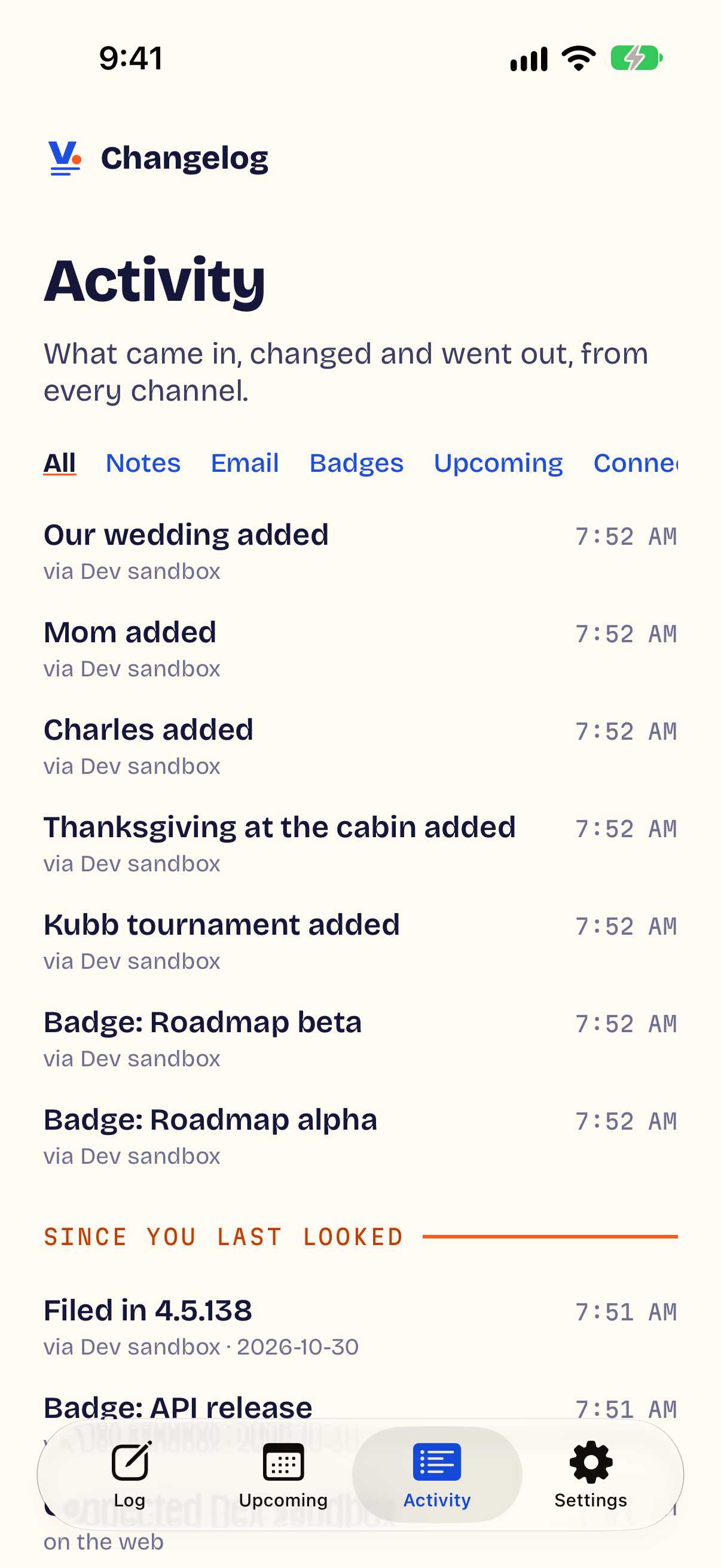
For its first day it wore iOS’s own look: grouped lists on gray, the system font, and blue links. On October 30 he asked for it to match the Release Notes website, and every screen, sheet, and widget moved onto the site’s paper: cream and navy, cobalt for actions, a tangerine Commit, and the site’s two typefaces, Bricolage Grotesque and Martian Mono. The screens below show each one before and after, taken on the simulator against the Release Notes dev server and its fictional account.
On October 31, 2026, Jamie explored separate icons for Changelog and Release Notes with Codex. The single folded v and its dot went to Release Notes. For Changelog he chose three folded v marks stacked diagonally, called Versions. Paper, Copper, Terminal and Afterglow followed as member-edition studies. The design record keeps the discarded direction, the refinements and the generation prompts.
It numbers itself the way Release Notes numbers people. Changelog was 0.0.0 on the day it started and 0.0.1 the next, and the foot of Settings names each build’s version and commit. What each version brought is written up as Release Notes for Changelog on the Release Notes site, which also has the TestFlight invitation. Its code is open on GitHub under the MIT License. His cousin Quinn, he said, is “working alongside me to build an Android version of Changelog that works with it”.
The build #
- The app talks only to Release Notes’ public /v1 API. Signing in is OAuth with PKCE, and the code that comes back is spent once for an ordinary API token, with no refresh token.
- Every write goes through an offline queue with an idempotency key, so a note written without a connection waits on the phone, and a resend never makes a duplicate.
- ChangelogKit, a Swift package with the API client, the queue, a port of Release Notes’ hashtag rules, and the Keychain storage, is tested on its own. The app, the share extension, and the widgets are SwiftUI on top of it, with no third-party packages.
- A test cycle drives the app on a simulator against the Release Notes dev server and its fictional account, and checks each note, photo, voice memo, and date against what the server kept.
Swift and SwiftUI iOS 26 App Intents WidgetKit Release Notes API TestFlight
The record #
- Status
- Active Jamie is building or running it.
- Lifespan
- Across the years from 2003 to 2026. Each dot is an event in its history.
- Story
- In his words
- Session 2, question 12 · Session 3, question 19
- Topics
- Play
- Latest evidence
- Latest commit, Nov 10, 2026
Artifacts #
Files from the project itself, kept as they were. All 27 on one page.
The plan #
The API plan #
Tokens, a public API and Changelog as one idea with two doors: what the API would do, the order to build it in, and Jamie’s calls on each question, quoted as he gave them. Every phase of it was built that day. Taken out: a cousin’s name, an email address, and one sentence.
The app’s scope #
Changelog’s screens sketched in text, notifications with no push server, and a table checking each thing the app would do against the API plan, which changed the plan before any of it was built. Taken out: a cousin’s name and an email address.
The first scaffold #

The icon #
The shared V and dot over two lines of notes, from the first scaffold, before the separate icon studies below.
The first README #
From the first scaffold, before the API it talks to was live. Photos and voice memos, Upcoming, and Shortcuts and widgets are listed for later versions; all three arrived that same day.
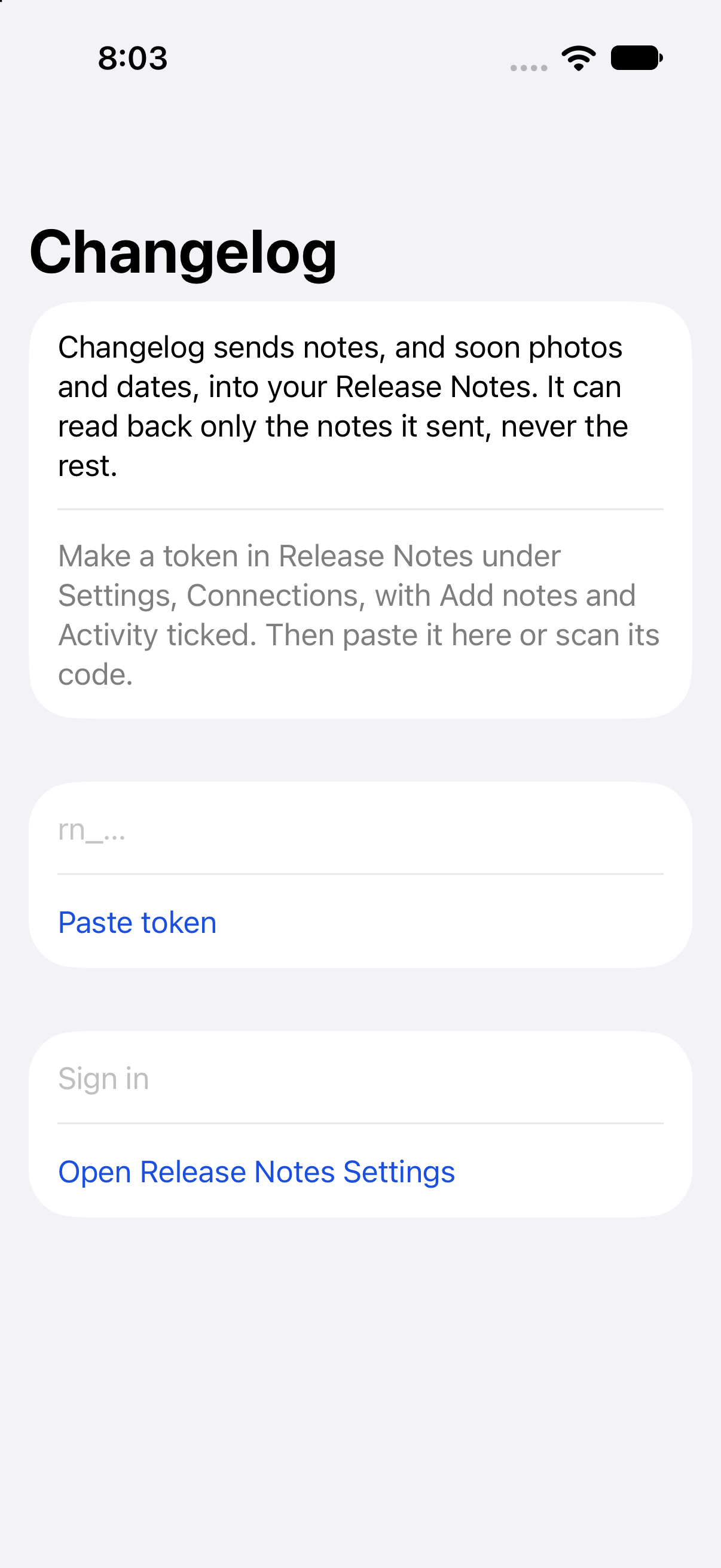
The first screen #
The first scaffold’s sign-in, that morning, which took a token pasted from Release Notes’ Settings. Signing in with Release Notes itself came that evening.
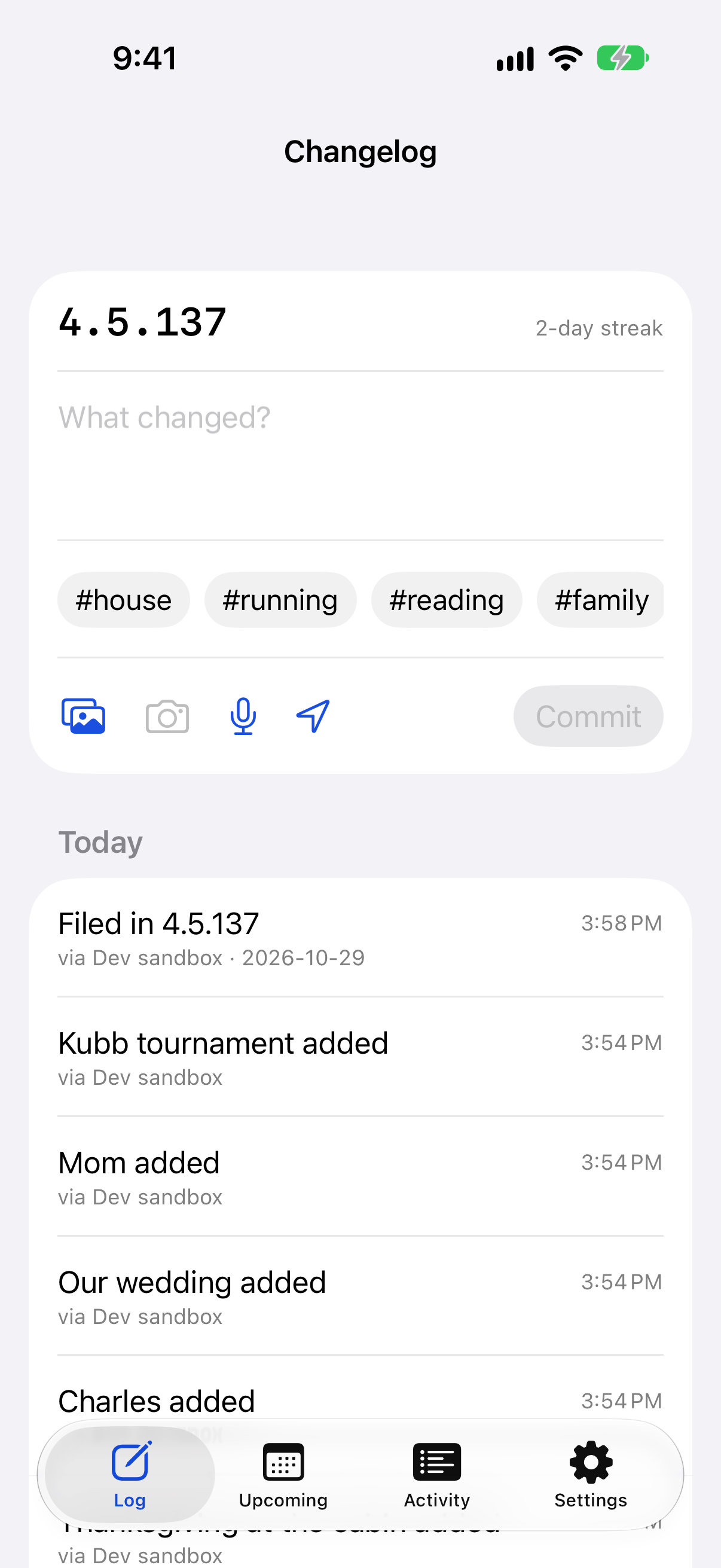
Log, in iOS’s own look #
Today’s version, a box for what changed, one-tap tags, buttons for a photo, the camera, a voice memo and the place, and Commit, with today’s activity underneath.
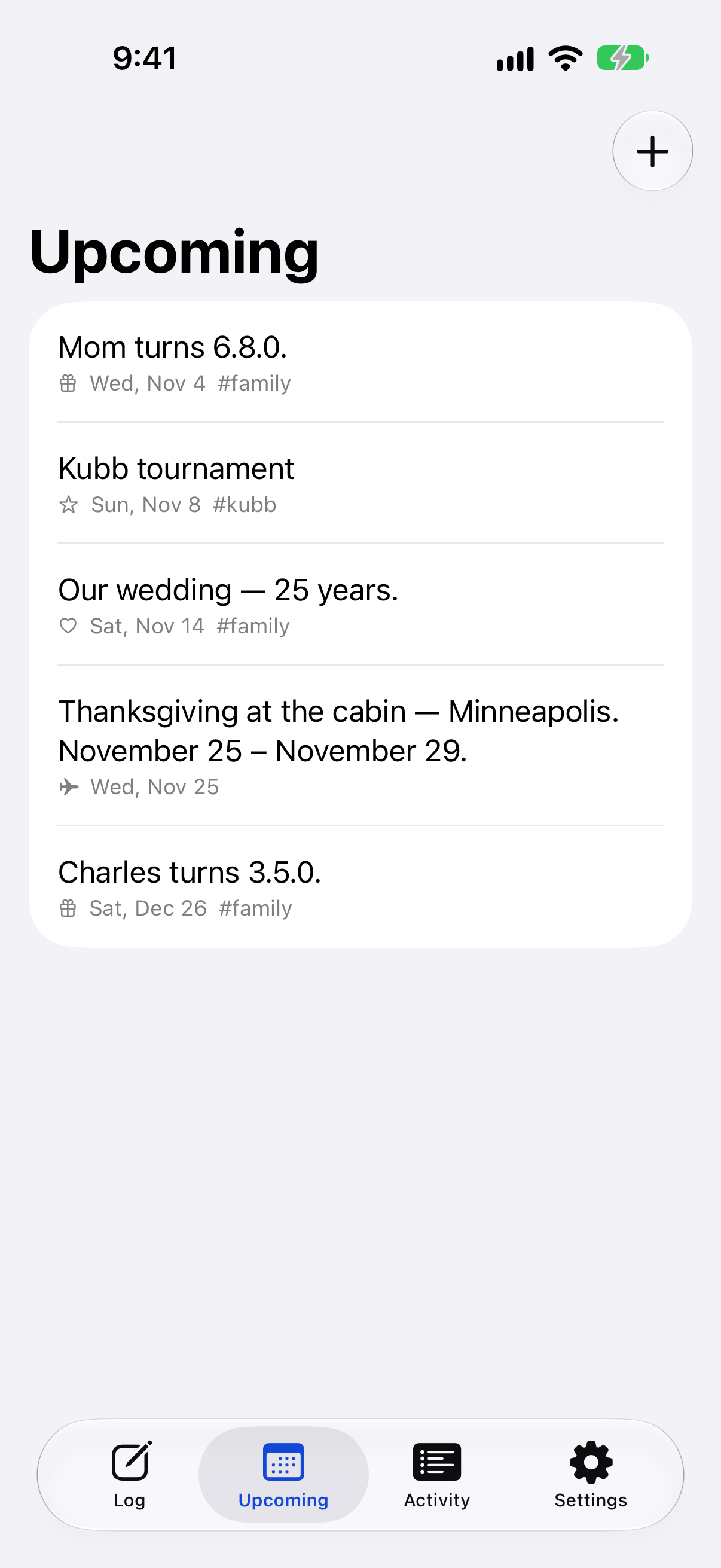
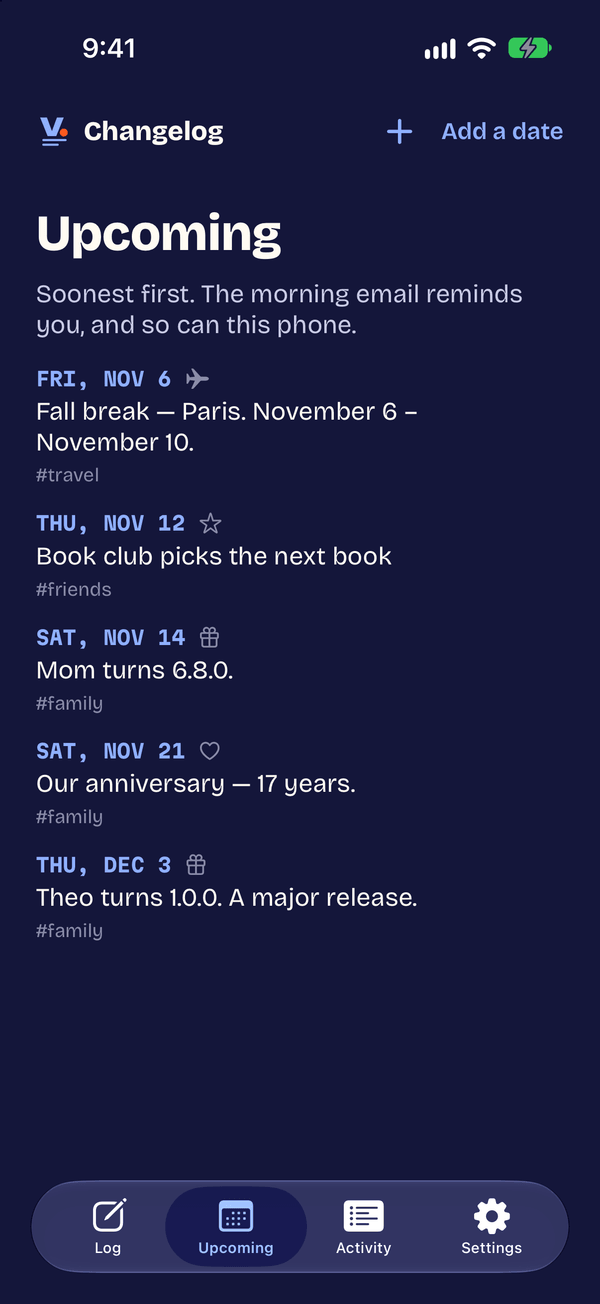
Upcoming #
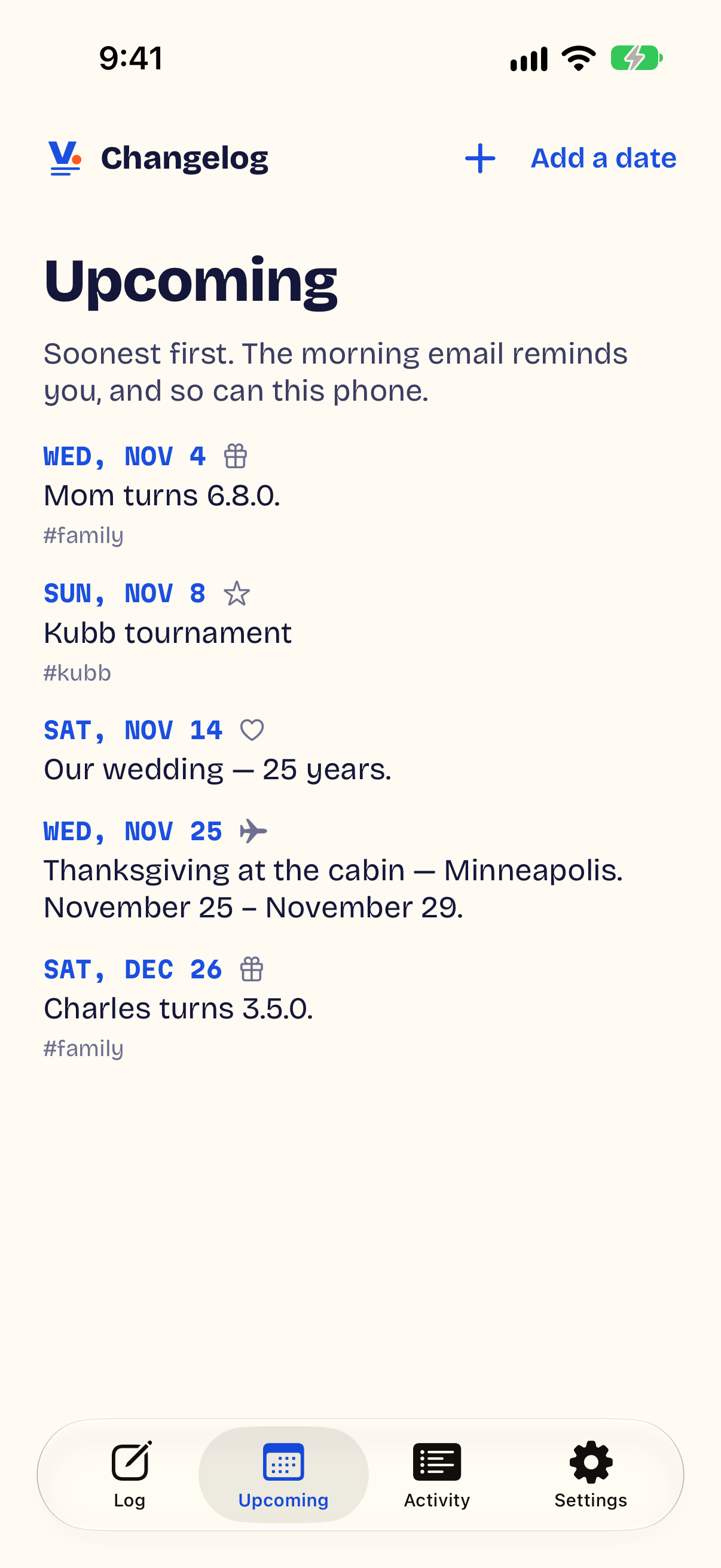
Birthdays, an anniversary, a trip and an event, each in the line the morning email gives it, like “Mom turns 6.8.0.”
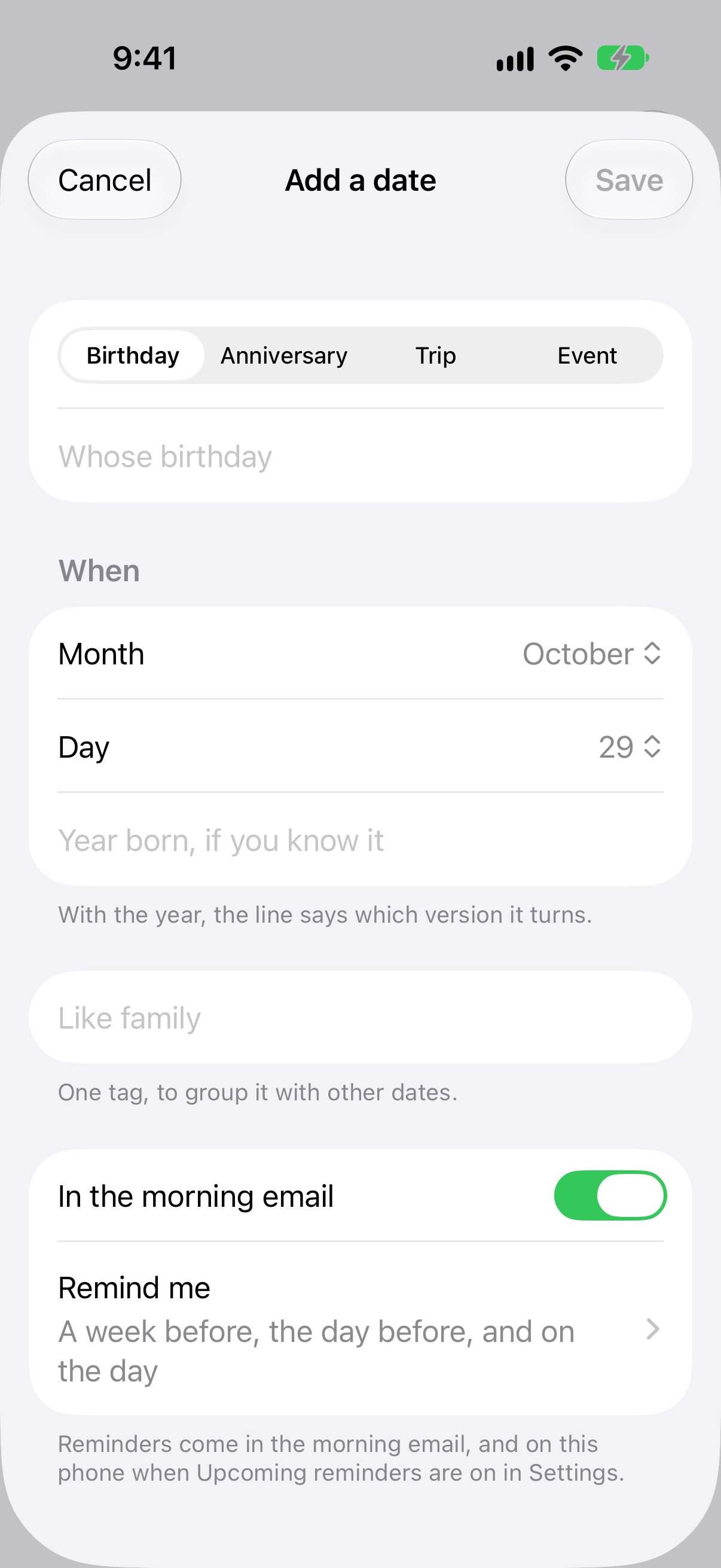
Adding a date #
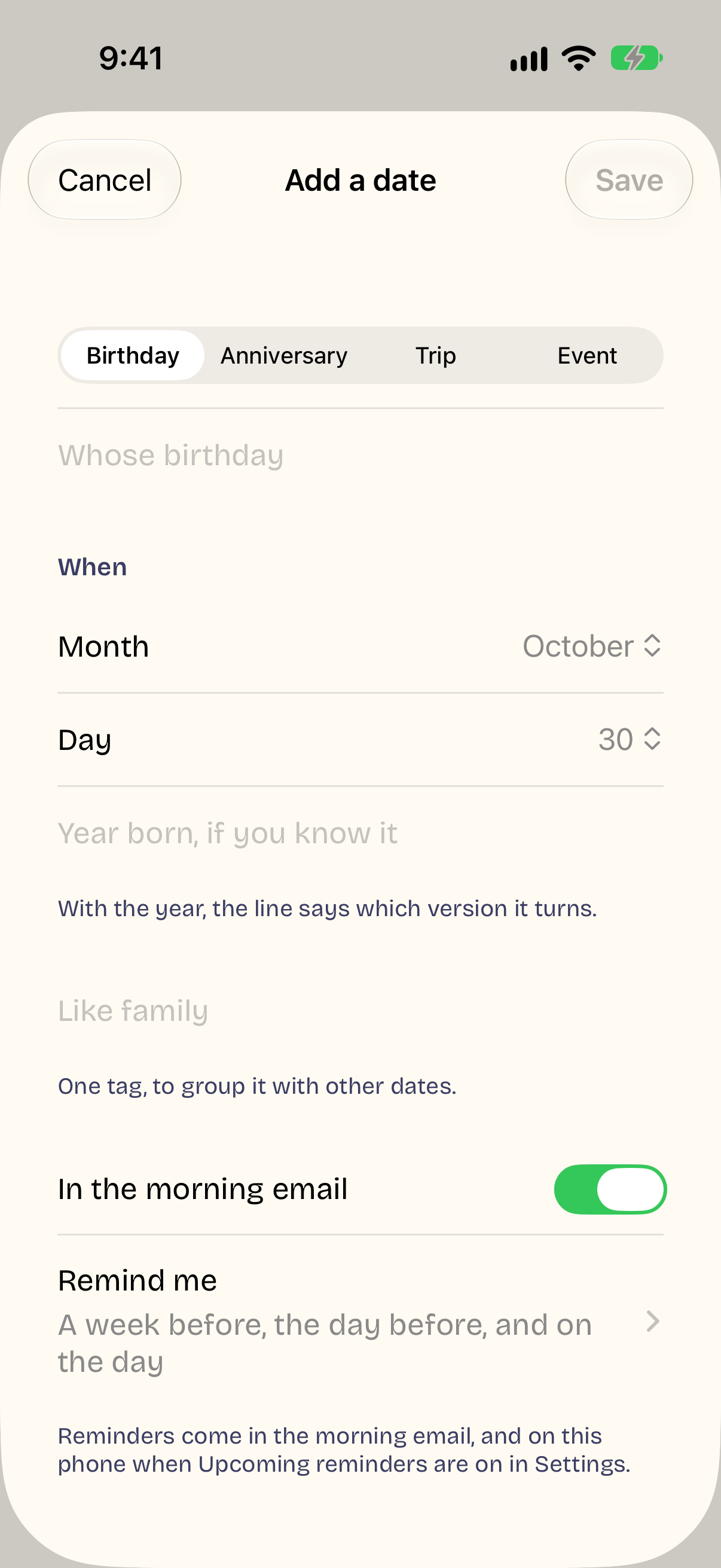
A birthday, anniversary, trip or event, whether it goes in the morning email, and when the phone sends its reminder.
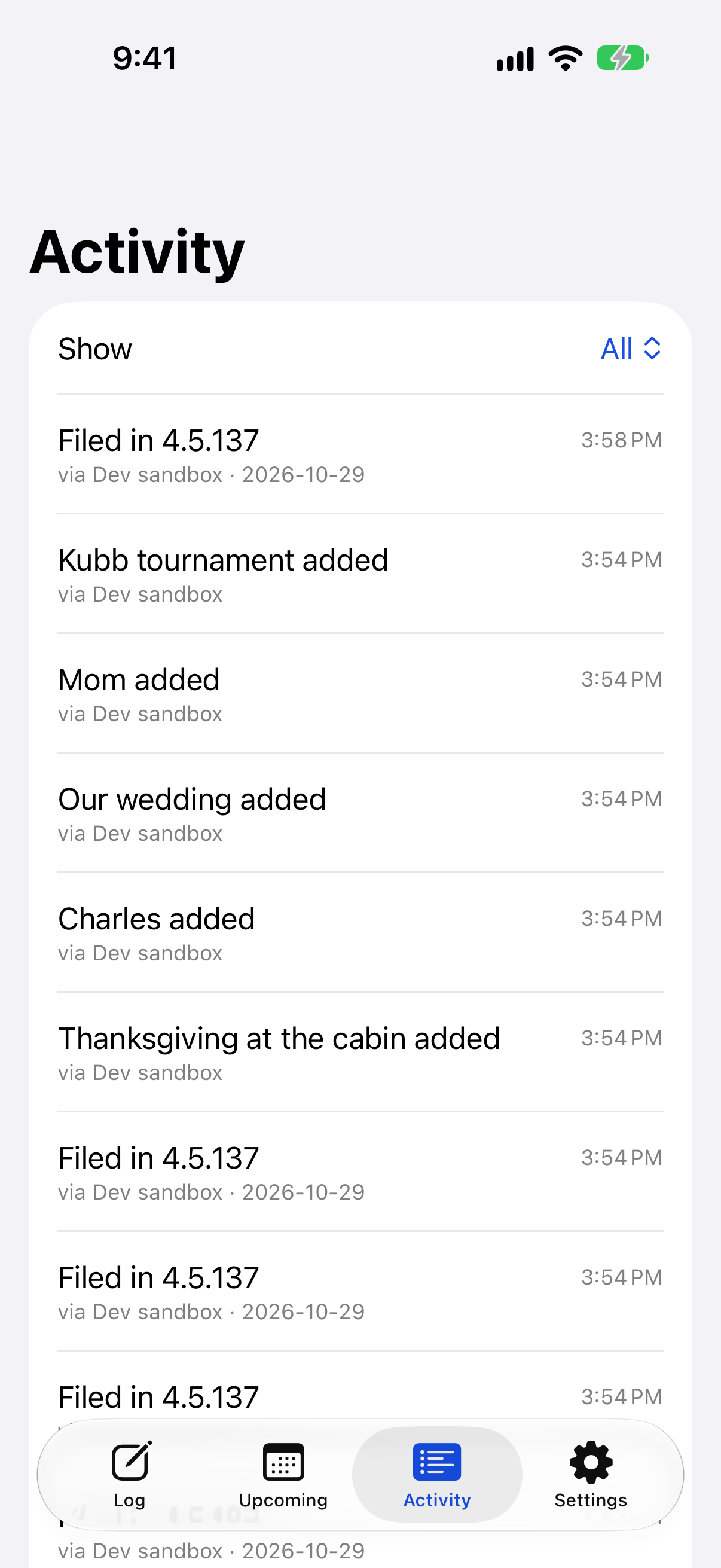
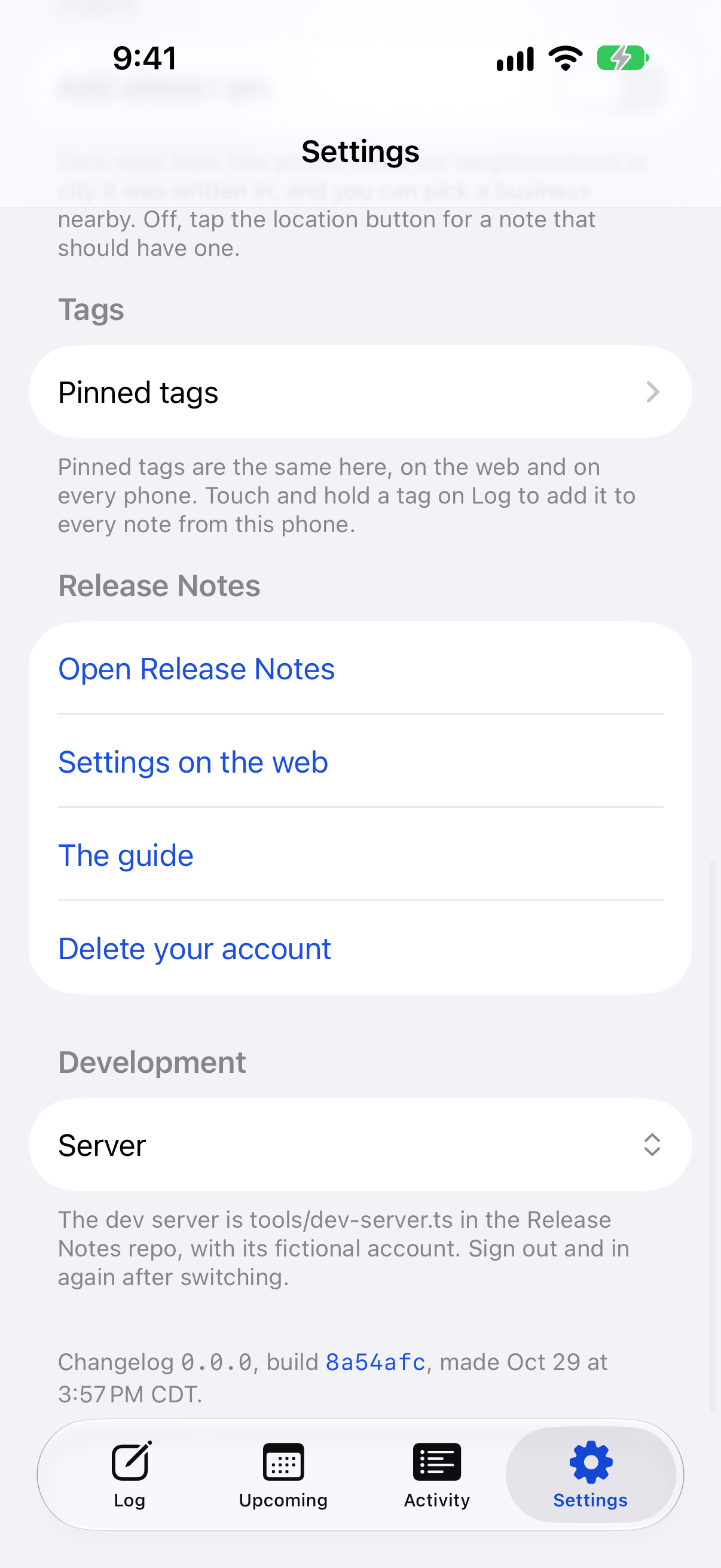
The foot of Settings #
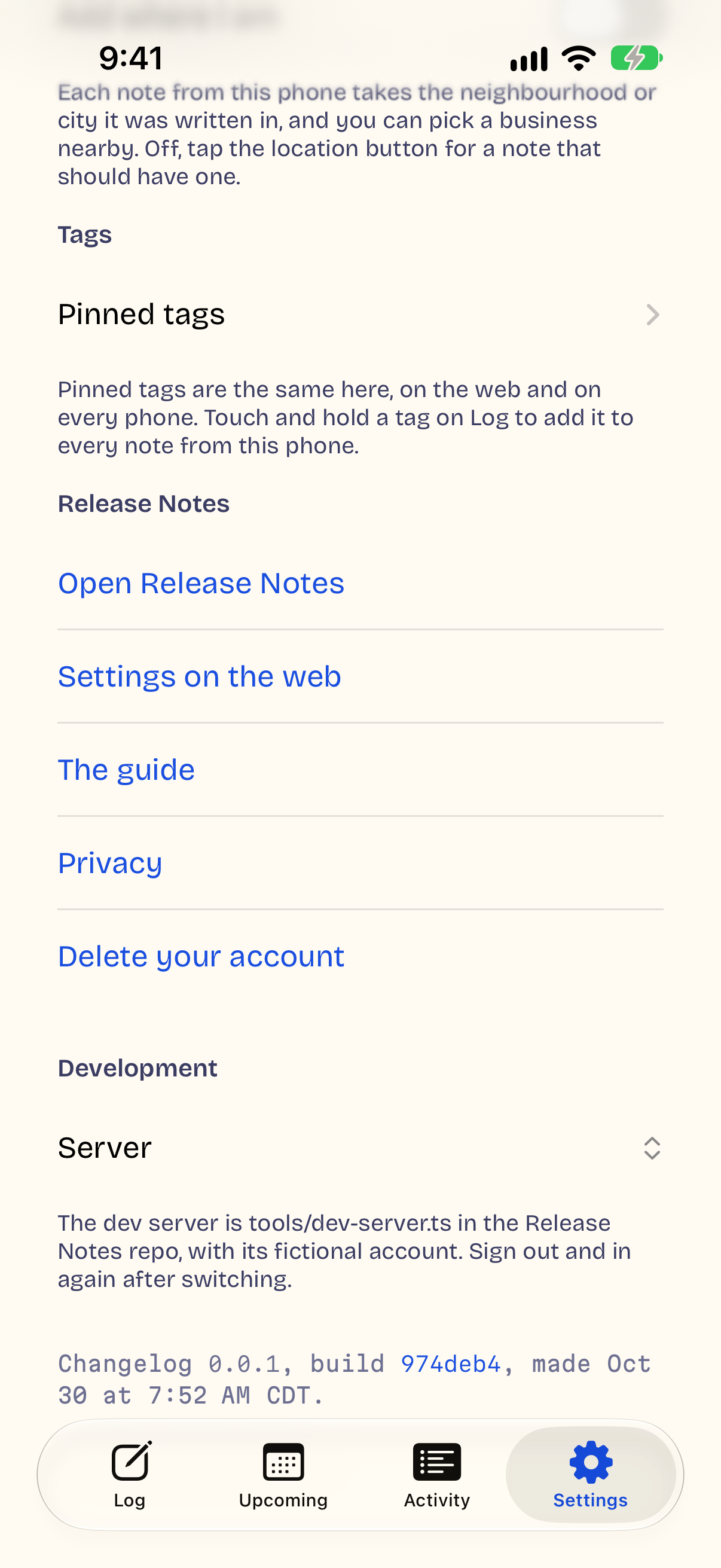
Pinned tags, links to Release Notes, a debug build’s server switch, and the build line: Changelog 0.0.0, build 8a54afc, made Oct 29 at 3:57 PM CDT.
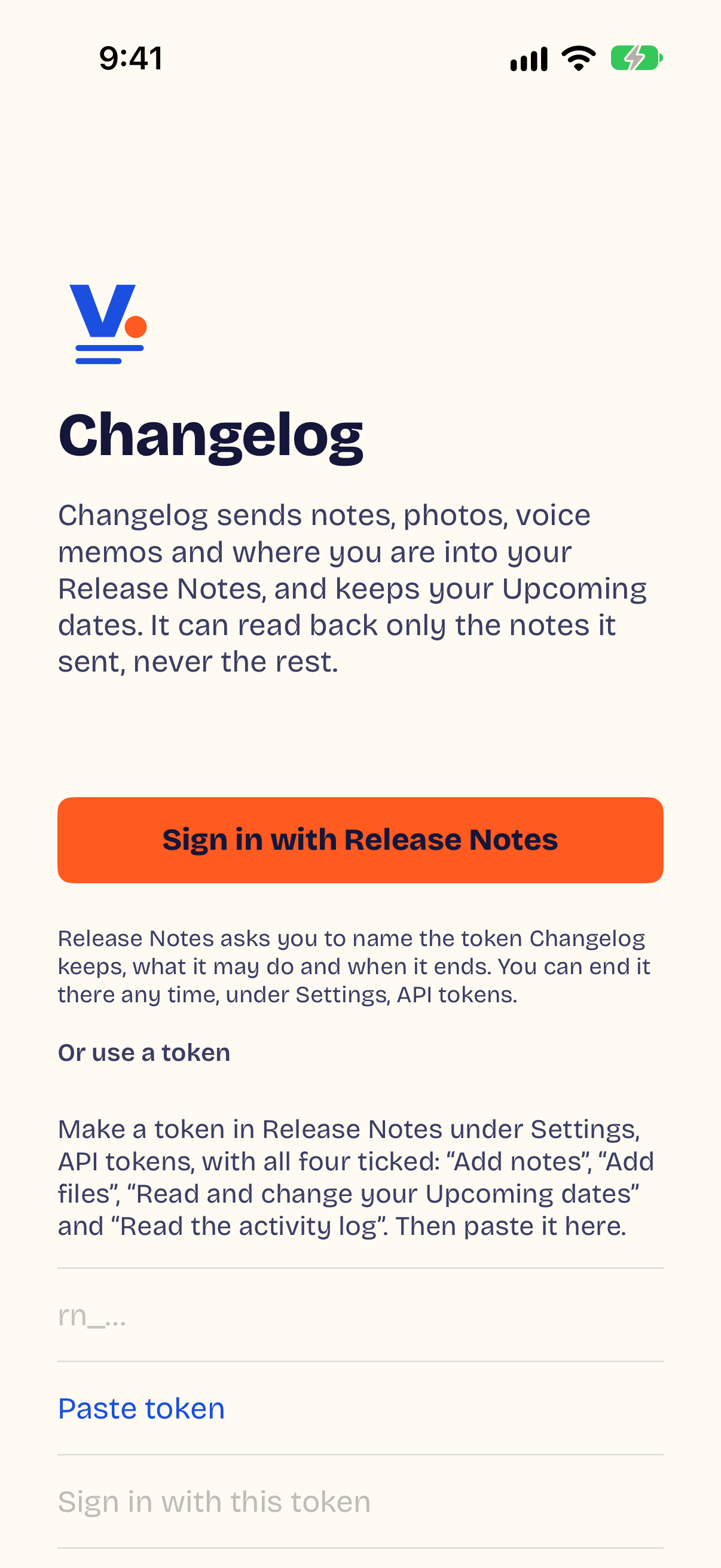
Signing in #
By now Changelog signs in with Release Notes itself, which asks the person signing in to name the token it keeps and choose what it may do. A pasted token still works.
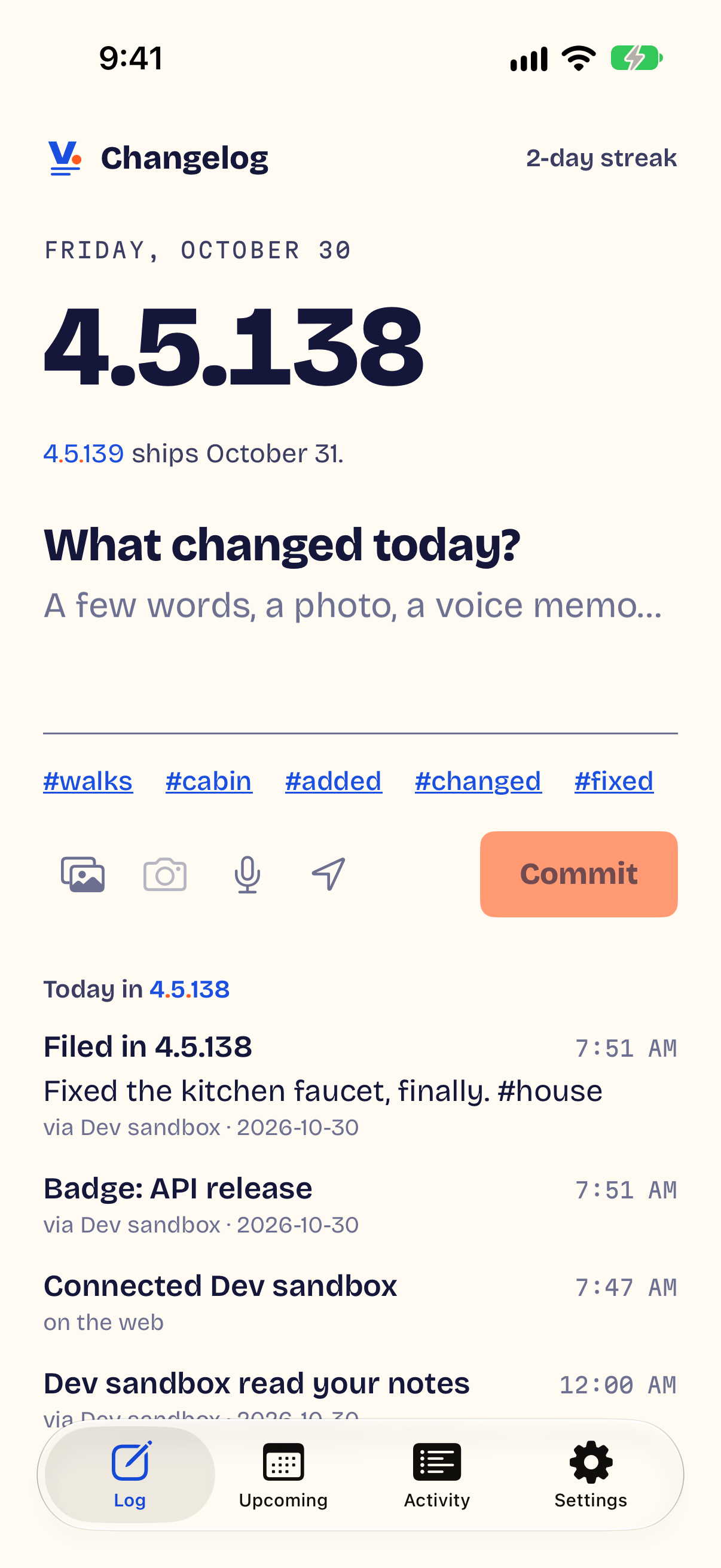
Log on the paper #
The day in mono capitals, today’s version large and tomorrow’s under it, and below, a note filed and read back with its words.
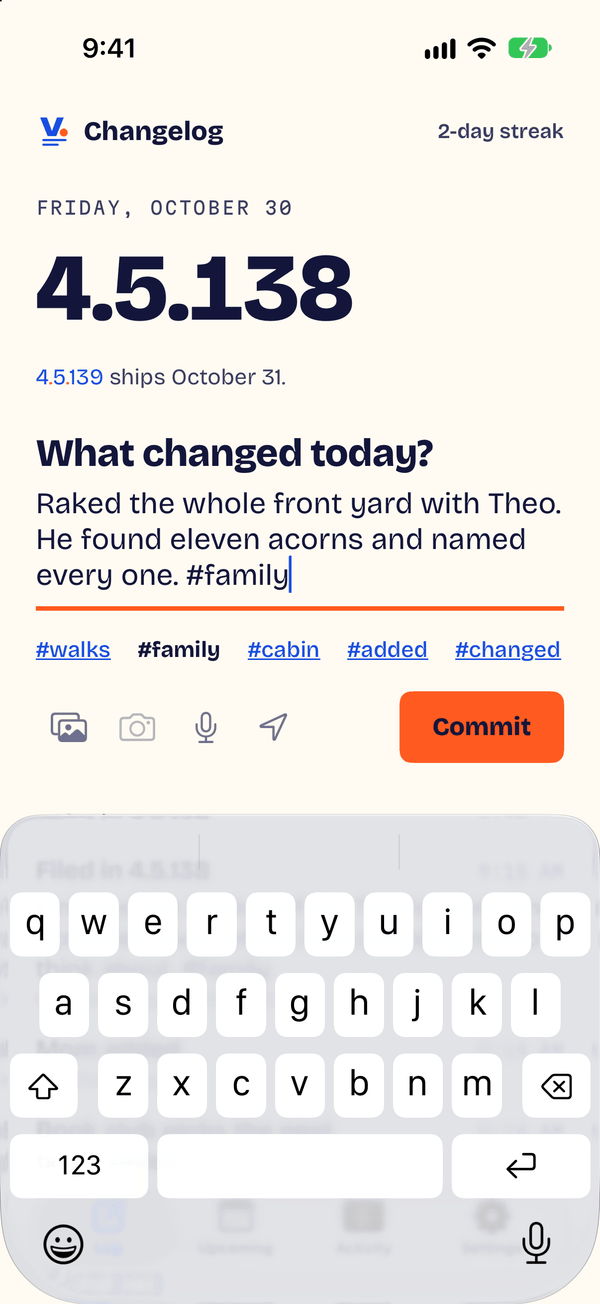
Log, as the guide shows it #
The screenshot on Release Notes for Changelog, the app’s page on the Release Notes site.
Finding a separate icon #

Entries, set aside #
Three curled paper slips on tangerine, each with a cobalt dot. This was the list-based alternative to repeating the version mark.

Versions, the first stack #
Three folded v marks in cobalt, tangerine and ivory on ink navy. This became the direction for Changelog.

Versions, refined #
The stack with more clear space around its edges and simpler fold shading. It was checked at 60 pixels beside Release Notes’ single v and dot.




The design record #



Activity #
103 commits (101 with Claude, 2 by Jamie), the first on Oct 29, 2026.
The latest weeks with activity
-
Week of Nov 9, 2026 8 commits, all with Claude
-
Week of Nov 2, 2026 14 commits, all with Claude
-
Week of Oct 26, 2026 81 commits (79 with Claude, 2 by Jamie)
Year by year, all of it. Who made each commit is from its author and co-author lines.
Sources and evidence #
Checked every day from GitHub, sitemaps, feeds, the Internet Archive, and Tinylytics. Evidence never sets a status. That is Jamie’s call.
-
jthingelstad/changelog-ios implementation
Changelog: a fast iPhone app for sending notes, photos and dates into Release Notes
- Repository created Oct 29, 2026 (when the code started, not when it launched)
- Swift, Shell
- Latest commit Nov 10, 2026; 103 commits on main between Aug 1, 2026 and Nov 10, 2026
- Observed Nov 10, 2026
Commits and publications per month, last twelve months.
Connections #
-
Changelog sends notes into Release Notes
Changelog talks only to Release Notes’ public API, as any app someone writes for it can. It signs in with Release Notes, which asks what it may do and gives it a token of its own. Source
History #
-
milestone
Changelog on TestFlight
The first build of Changelog, Jamie’s iPhone app for Release Notes, goes to TestFlight the day he starts it. It adds notes through Release Notes’ public API, as any app someone writes for it can. Source