WikiApiary
A Semantic MediaWiki site that tracks thousands of MediaWiki wikis, their software, extensions, and editing activity.
Retired wikiapiary.com/wiki/Main_Page
On this pageJump
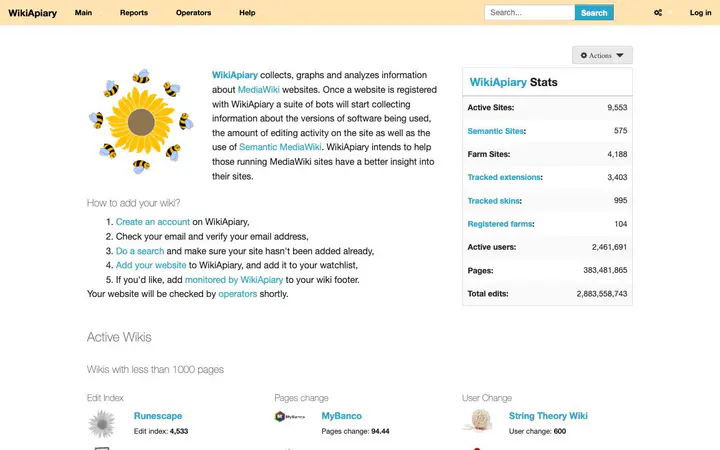
WikiApiary is “a wiki to track other wikis.” Once a MediaWiki site is registered, a set of bots collects its software versions, extensions, skins, and editing statistics, and the wiki keeps the history so it can be charted and queried. It is built with MediaWiki and Semantic MediaWiki. Jamie started it as a holiday-break project in 2012; MediaWiki.org dates it to December 21, 2012. On Open Loop #7 in January 2013 he said he built it “in about three days,” after Semantic Result Formats’ charts showed him he could graph wiki statistics, and that Garrick van Buren came up with the name: the MediaWiki logo is a sunflower, the bots are like bees, and a collection of hives is an apiary.
After its first year it was collecting from 9,555 active wikis and had stored more than 1.8 billion statistics samples, with over 3.3 million property values of its own (One Year for WikiApiary). It was the first project he started that grew a real community around it. Karsten Hoffmeyer helped administer it, Mark Hershberger explored ways for wikis to register themselves, Paul DeCoursey rewrote the chart code, and Federico Leva linked MediaWiki.org’s extension pages to their WikiApiary pages, which brought much of its traffic. What he saw in the platform:
Very simply, Semantic MediaWiki. I loved what you could build by bringing data and text together in a way that let you play with surfaces like they were clay. All of those sites were fundamentally built out of Semantic MediaWiki.
When he decided he was done with it, others took it on. Mark Hershberger wrote in April 2017 that he had “inherited the site from Jamie Thingelstad.” That October, Hershberger and his son Basil began moving it from the old Linode servers to Wikimedia Cloud Services. At its size the wiki has struggled with database timeouts ever since: it came back online in March 2023 after an upgrade to MediaWiki 1.39, was in write-only mode by that September, and MediaWiki.org marked it not operational in February 2025. Jamie’s own account of why: “If you think about how WikiApiary worked, hack is the best term you could apply to it. But I still think those concepts are super fun”. The wiki projects, he said, “all fell under their own weight because of the complexities and challenges of MediaWiki underneath”.
In March 2026 Brian Wolff got the site serving pages again, with the update bots still off, and in May 2026 Hershberger announced from the Wikimedia Hackathon that WikiApiary and its bots were moving to a Kubernetes cluster so it could start crawling wikis again.
The record #
- Status
- Retired No longer available. Jamie ended it on purpose.
- Lifespan
- Across the years from 2003 to 2026. Each dot is an event in its history.
- In his words
- Session 2, question 16
- Topics
- MediaWiki Semantic MediaWiki
- Latest evidence
- Latest commit, Oct 30, 2026
Activity #
286 commits (278 by Jamie, 8 by others), the first on Jan 6, 2013.
The latest weeks with activity
-
Week of Mar 9, 2015 1 commit by Jamie
-
Week of Feb 9, 2015 2 commits, all by others
-
Week of Sep 1, 2014 1 commit by Jamie
-
Week of Aug 11, 2014 1 commit by Jamie
Year by year, all of it. Who made each commit is from its author and co-author lines.
Sources and evidence #
Checked every day from GitHub, sitemaps, feeds, the Internet Archive, and Tinylytics. Evidence never sets a status. That is Jamie’s call.
-
wikiapiary.com/wiki/Main_Page website
- First archived Dec 31, 2012 by the Internet Archive (existence evidence, not a launch date)
- Observed Oct 18, 2026
-
web.archive.org/web/20131218002106/http://wikiapiary.com/wiki/Main_Page archive
- First archived Dec 31, 2012 by the Internet Archive (existence evidence, not a launch date)
- Observed Oct 18, 2026
-
WikiApiary/WikiApiary implementation
Celery-based task workers for collecting and updating data on WikiApiary.
- Repository created Jan 6, 2013 (when the code started, not when it launched)
- 31 stars and 9 forks on GitHub
- Python, PHP, JavaScript
- Latest commit Mar 14, 2015; 0 commits on develop between Jul 20, 2026 and Oct 18, 2026
- Observed Oct 18, 2026
-
WikiApiary/wikibees successor
The WikiApiary Wikibots
- Repository created Sep 4, 2016 (when the code started, not when it launched)
- Python, PHP, JavaScript
- Latest commit Oct 30, 2026; 16 commits on master between Jul 1, 2026 and Oct 30, 2026
- Observed Oct 30, 2026
Commits and publications per month, last twelve months.
Connections #
-
WikiApiary is skinned with Foreground
WikiApiary’s distinctive look came from the Foreground skin, which Garrick van Buren built and Jamie worked on for WikiApiary. Source
-
Open Loop discussed WikiApiary
Episode 7, in January 2013, told how Jamie built WikiApiary in about three days and how Garrick named it. Source
History #
-
milestone
WikiApiary in new hands
Mark Hershberger writes that he inherited WikiApiary from Jamie and is keeping it running. Source
-
milestone
One year of WikiApiary
A first-year retrospective describes the growing wiki community and credits Foreground as the site’s skin. Source
-
launch
A wiki to track other wikis
WikiApiary begins as a holiday-break project, built with MediaWiki and Semantic MediaWiki in about three days. Source