Things · Developer tools and systems
Gnosis Validator
Thirty-two Gnosis Chain validators that Jamie has run at home on a Dappnode since September 2022.
Active
On this pageJump
The Gnosis Validator is a small computer in Jamie’s house that helps run Gnosis Chain. On it are thirty-two validators, each one taking its turn to attest to the chain and, now and then, to propose a block.
On September 3, 2022 he ordered a Dappnode Home i732, a mini PC sold ready to run a node, and said why Gnosis: “I’m a big fan of POAP and Nifty.ink, both of which run on Gnosis. This seems like the easiest path exploring home staking.” Six days later it was syncing, and he found it “relatively easy to get setup.”
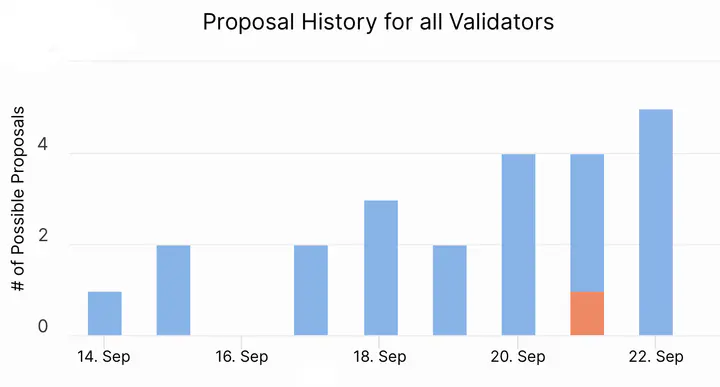
The first four validators went live on September 14. That night he added four more, and one of them proposed block 4,830,917. A week later they made five proposals in a day: “New high.” On September 29 he claimed and staked four GNO from a Dappnode promotion, which brought him to twenty. By October 1, 2022 the chain counted all thirty-two.
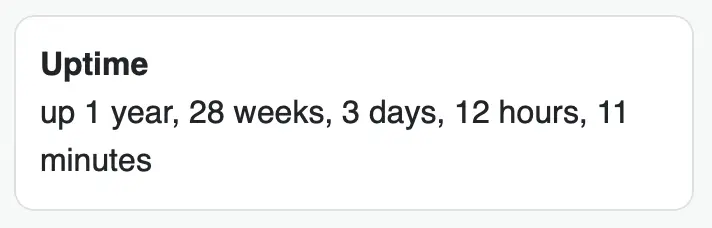
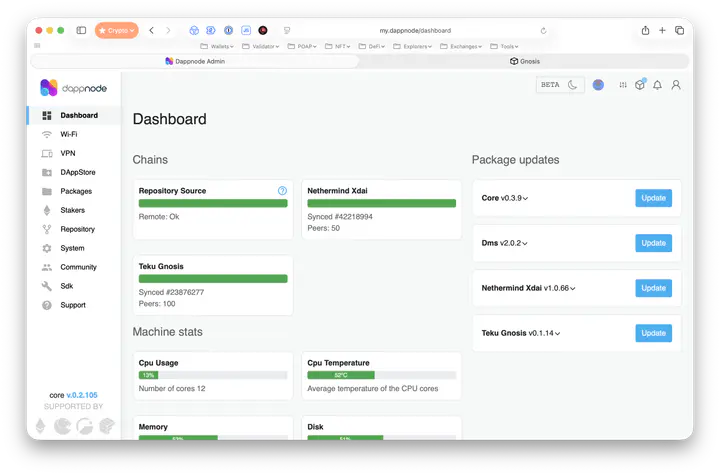
Then it ran. In September 2025 he checked in on it and found it had been up for a year and twenty-eight weeks, with four packages waiting for updates. A couple of reboots later everything was current, “never needing to do anything other than use the web browser.” His note to himself: “I’ll try not to wait over a year to do the manual updates next.”
It ran until spring 2026. Around May 10 the validators stopped attesting, and nobody noticed for six months. When Jamie looked on November 12, the consensus client, Teku, was restarting in a loop: its database had grown to 596 GB, and it had been down so long that it refused to pick up where it left off, outside what the chain calls the weak subjectivity period. All thirty-two were still active and none had been slashed. An offline validator only gives up a little of its stake each epoch, but six months of epochs add up. He cleared Teku’s data and had it start over from a recent checkpoint. That took a second try, because the checkpoint server Dappnode sets up answered with a redirect Teku would not follow; Gnosis’s own server worked. Teku was synced that evening, and the execution client, Nethermind, set to work on six months of blocks. Since then a check reads the validators from the chain every morning, so the next silence will be a short one.
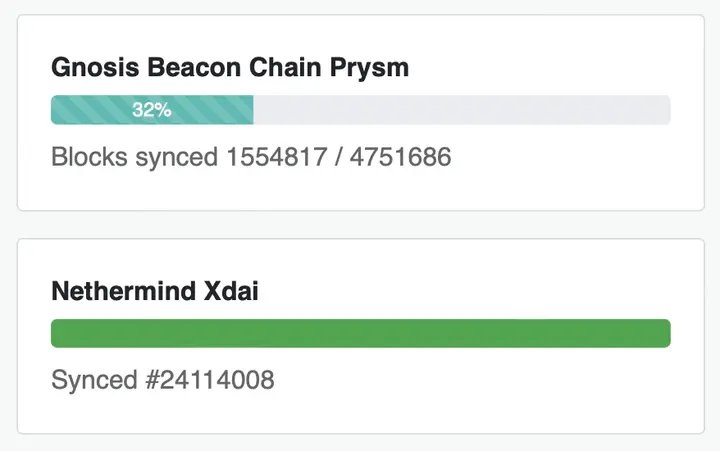
One detail from the workbench: the screenshots from the first night and the one in 2025 show different consensus clients, Prysm in 2022 and Teku by 2025. The box changed what it ran on the inside while the validators kept their numbers.
The record #
- Status
- Active Jamie is building or running it.
- Lifespan
- Across the years from 2003 to 2026. Each dot is an event in its history.
- Topics
- Crypto POAP
- Validators
- 32 of 32 active on the chain, none attesting, none slashed as of Nov 12, 2026
- Block proposals
- 3,398 proposed, 357 missed since Sep 15, 2022 Latest proposed May 10, 2026.
Gadget #
Gnosis Chain as it is this minute, read straight from the chain, with a dot for each of the 32 validators that lights while it attests. It runs in your browser, with JavaScript on.
On the chain now
Reading the chain.
Your browser reads this from Gnosis Chain’s public beacon node once an epoch, every eighty seconds. A dot is lit when that validator’s balance rose over the last two epochs, which is what attesting earns.
Artifacts #
Files from the project itself, kept as they were.
-
The first sync #
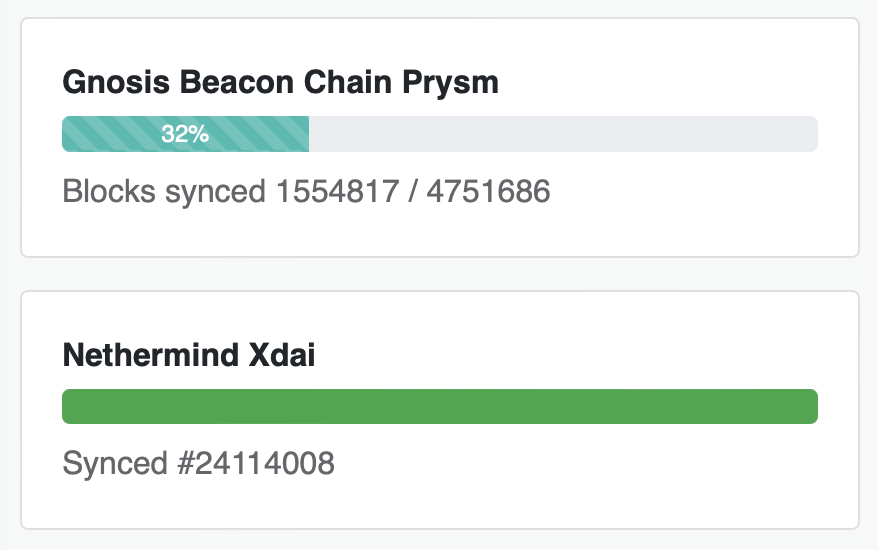
Two cards from the Dappnode dashboard on the first night. The Gnosis Beacon Chain on Prysm is 32 percent synced, 1,554,817 of 4,751,686 blocks, and Nethermind Xdai is fully synced at block 24,114,008.
-
Proposals in the first week #
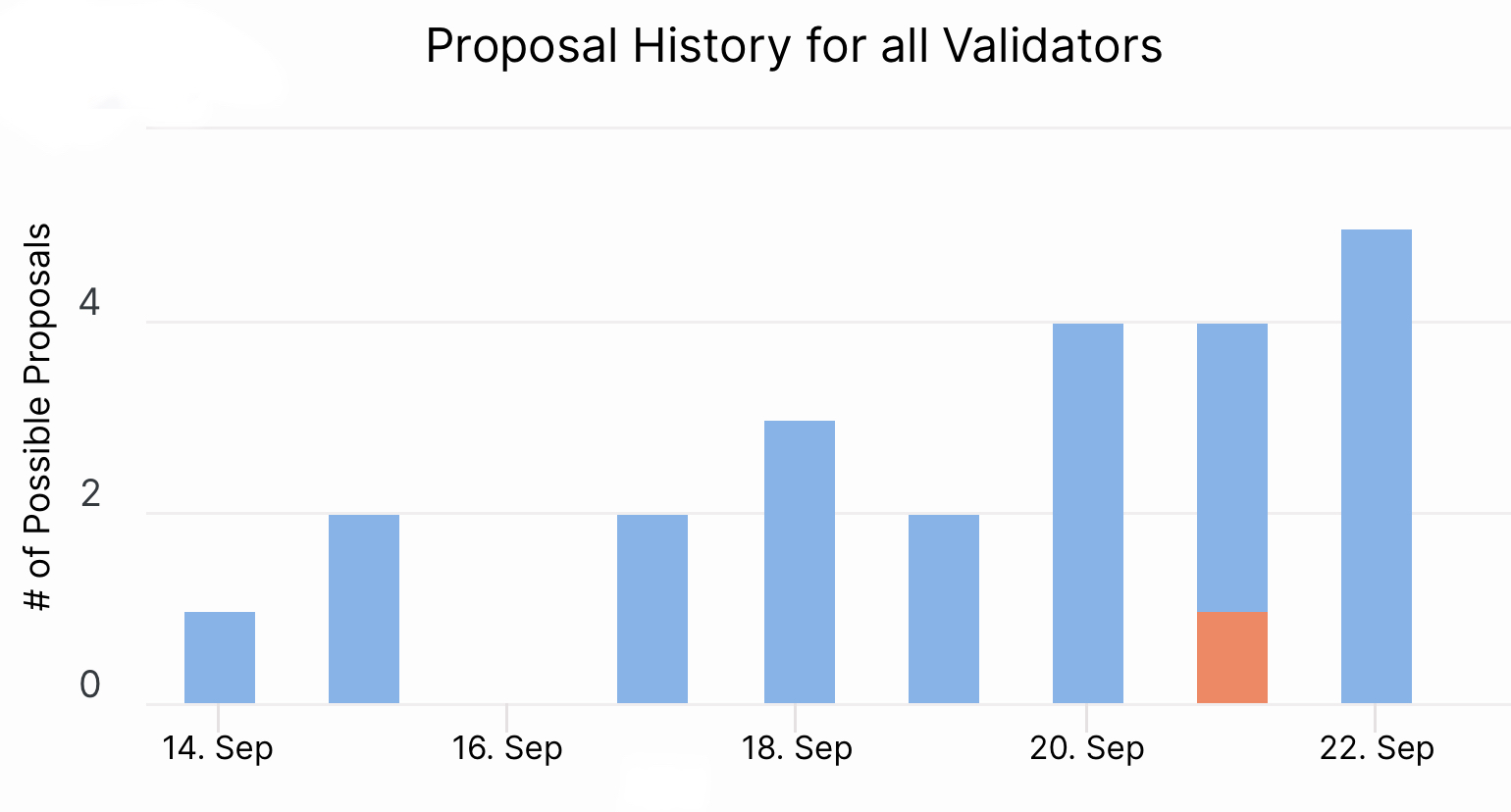
The explorer’s proposal history for all of his validators, September 14 to 22, 2022. The bars climb from one a day to five on the twenty-second, with one missed proposal in orange on the twenty-first.
-
One year, twenty-eight weeks #
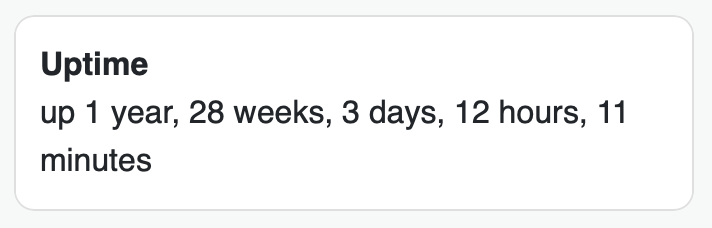
The Dappnode’s uptime card when Jamie checked in on it in September 2025, up 1 year, 28 weeks, 3 days, 12 hours and 11 minutes.
-
Four updates waiting #
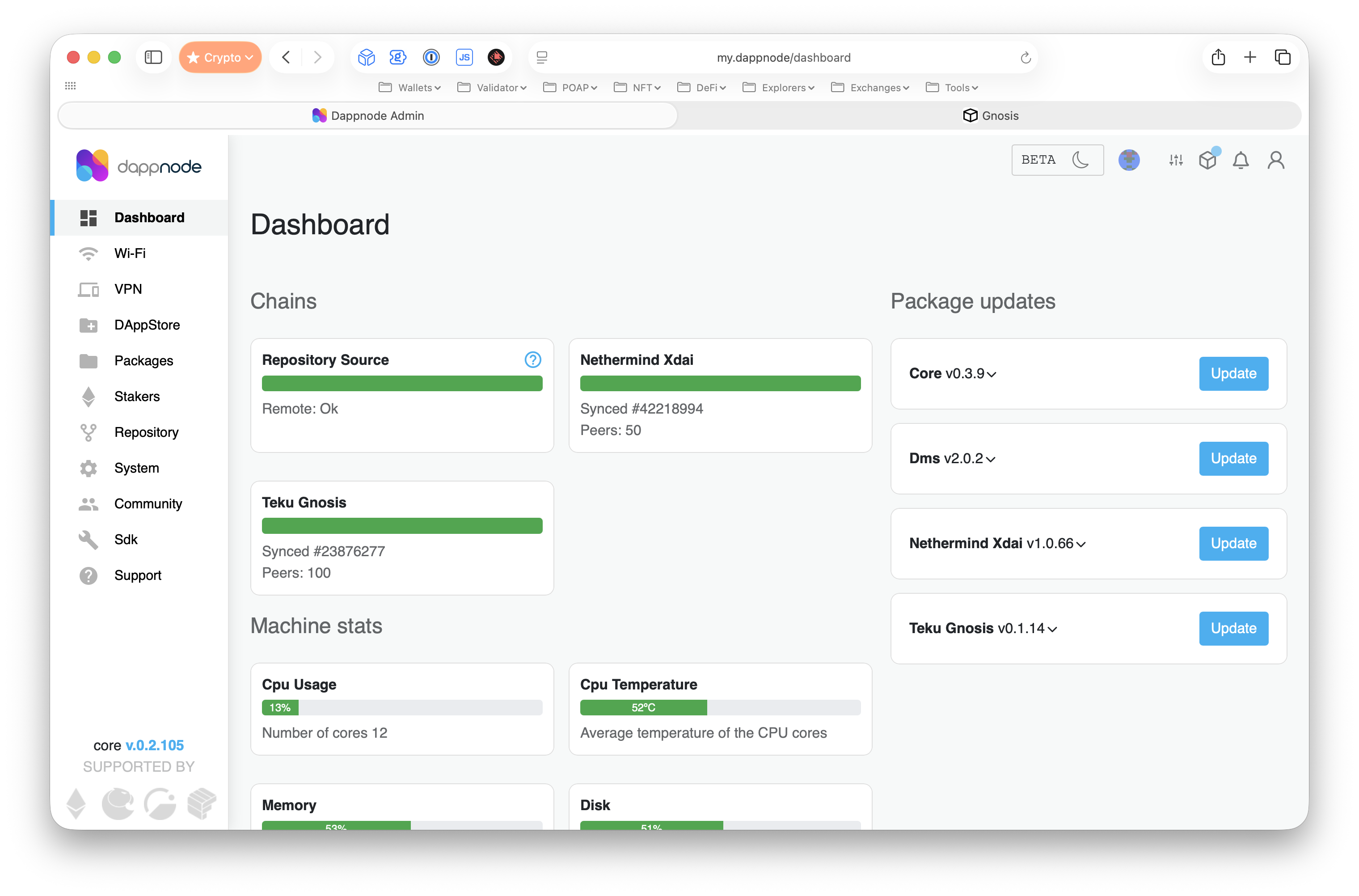
The Dappnode dashboard before the updates. Nethermind Xdai and Teku Gnosis are synced, the CPU is at 13 percent and 52 degrees, and Core, Dms, Nethermind Xdai and Teku Gnosis each have an update waiting.
-
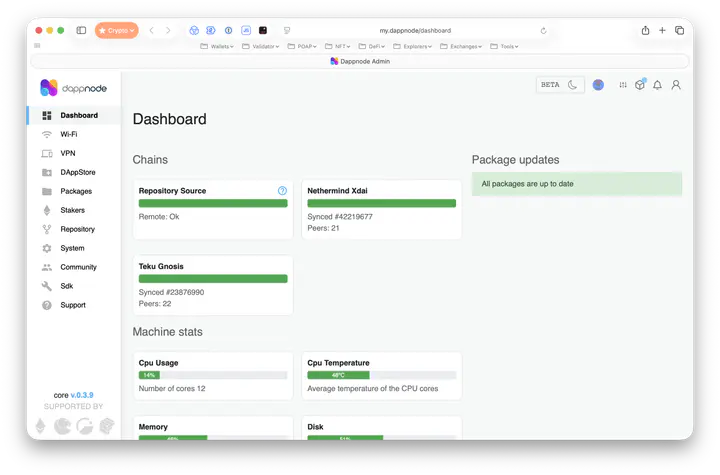
All packages up to date #
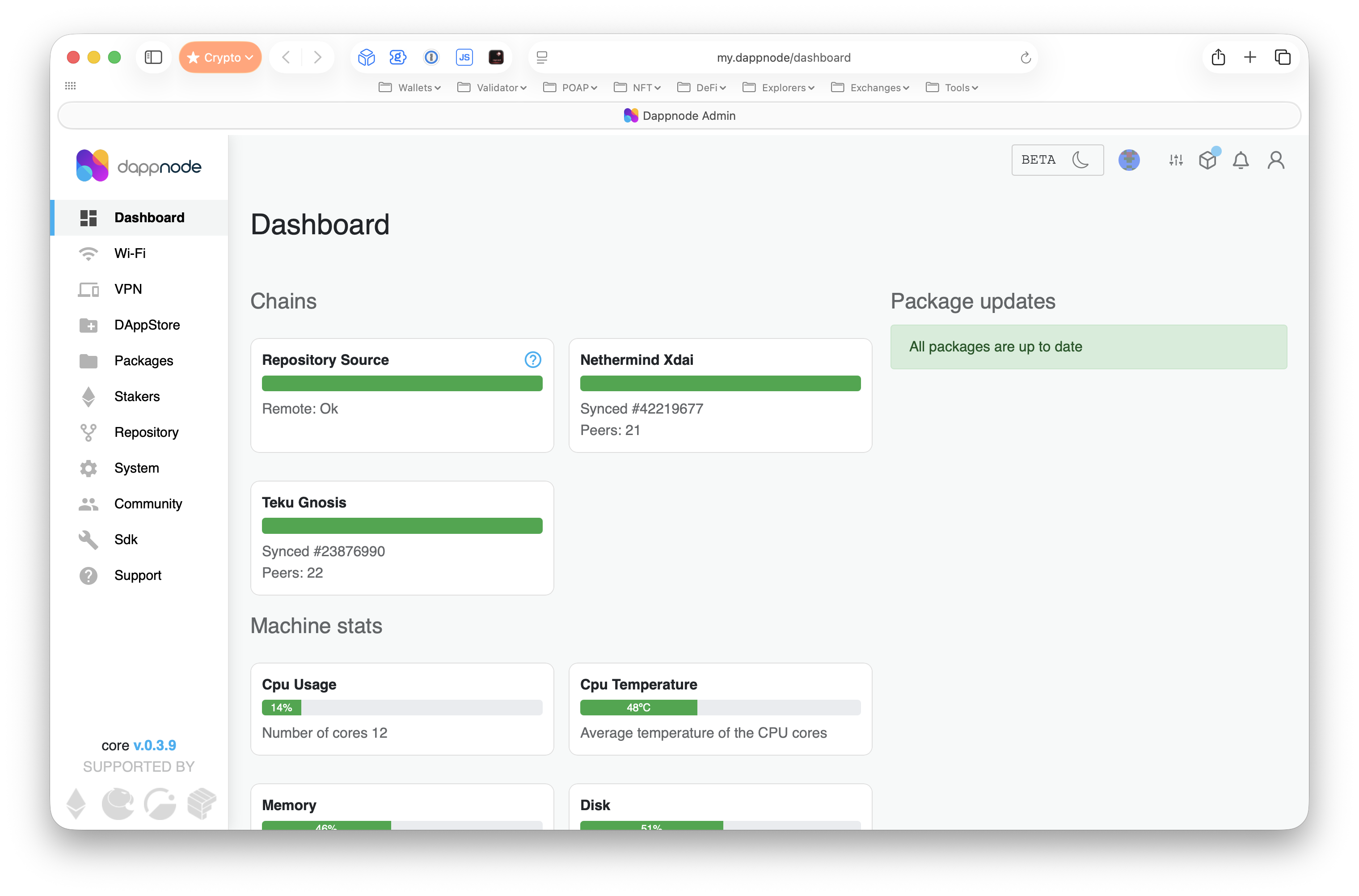
The same dashboard after a couple of reboots, with core v0.3.9 and every package up to date.


Sources and evidence #
Checked every day from GitHub, sitemaps, feeds, the Internet Archive, and Tinylytics. Evidence never sets a status. That is Jamie’s call.
-
www.thingelstad.com/2022/09/03/ordered-a-dappnode.html reference
-
www.thingelstad.com/2022/09/29/successfully-claimed-and.html reference
-
www.thingelstad.com/2025/09/20/dappnode-validator-year-weeks-uptime.html reference
Commits and publications per month, last twelve months.
Connections #
-
Gnosis Validator helps run the chain that holds Proof of a Person
Jamie’s POAP tokens live on Gnosis Chain, and POAP was one of the two reasons he gave for running a validator there. Source
-
Gnosis Validator helps run the chain that holds The nnxyz Rooms
Nifty Ink drawings were minted on Gnosis Chain, and Nifty Ink was the other reason Jamie gave for running a validator there. Source
History #
-
milestone
Six months offline
Jamie finds the Gnosis validators have not attested since about May 10, with Teku stuck outside the weak subjectivity period, and resyncs it from a checkpoint. All thirty-two were still active and none was slashed. Source
-
milestone
Updates after a year and twenty-eight weeks
Jamie finds the Dappnode up for a year and twenty-eight weeks and brings its four packages current. Source
-
milestone
Twenty validators
Jamie claims and stakes four GNO from a Dappnode promotion, bringing the count to twenty. Source
-
milestone
Five proposals in a day
The validators propose five blocks in one day, a new high in their second week. Source
-
launch
The first validators go live
Four validators start attesting on Gnosis Chain, and that night Jamie adds four more. Source
-
development
A Dappnode for Gnosis
Jamie orders a Dappnode Home i732 to run a Gnosis Chain validator at home. Source