Thingy
Jamie’s agent sidekick. On Ask Thingy he is the librarian, answering questions about everything Jamie has published with citations back to the original posts and issues, and he also keeps this site.
Ask the archive, get the sources.
Active thingy.thingelstad.com/
On this pageJump
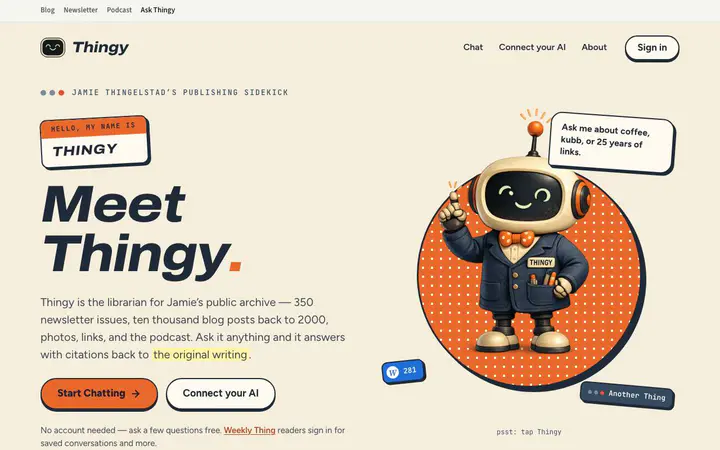
Thingy is Jamie’s agent sidekick, and on Ask Thingy he is the librarian of Jamie’s public archive. You ask him a question, like when Jamie first wrote about Ethereum or what he was reading in 2019, and he finds the posts and issues that answer it, quotes them, and links to the originals. He knows only what Jamie has published. Weekly Thing subscribers sign in with their email, and Supporting Members get larger daily budgets.
Jamie previewed Thingy in Weekly Thing 346 and launched him with the new Weekly Thing website on May 7, 2026. A month later, Thingy Evolved gave Thingy his own site and three archives to search, the newsletter, the blog, and the podcast, along with saved conversations, curiosity maps, voice input, and memory. In September Jamie added photos and shared conversations and was ready to call Thingy complete. In October Thingy got a new design, with Claude Sonnet for subscribers and Claude Opus for Supporting Members. Where he came from, in Jamie’s words:
Thingy was born from the idea that I really want something that lets a person converse with my writing over two decades and explore concepts and ideas. I think the current incarnation does that really quite well. As I’ve continued to work with Thingy and have it engage alongside me on different projects, it’s the first agent I’m allowing and actively bringing into other projects.
Behind Thingy is Librarian, a private archive API with no front end of its own. It holds working copies of every Weekly Thing issue, the blog posts pulled from Micro.blog, and the Another Thing episodes with their transcripts, and it builds the search indexes Thingy answers from. Its repository began as Studio, Jamie’s earlier publishing system. When publishing moved to WT Builder, what was left became Librarian. It also indexes this registry of things Jamie has built.
The same tools Thingy uses are offered as an MCP server at librarian.thingelstad.com/mcp. Weekly Thing subscribers can connect Claude, ChatGPT, or another AI to it and sign in with their email, with no password. The AI can then search the newsletter, blog, links, photos, and podcast, and link back to each source it uses. As described on Thingy’s about page, an AI agent spent eight review rounds trying to break the tools when the MCP server launched, and what it found shaped how matching works.
Since Weekly Thing 350, Thingy also writes two sections of each issue: Supporting Membership and Echoes, which connects the week’s topics to earlier issues. That is as far as the writing goes, under “my mandate that my words are my words and that AI isn’t writing for me”. Since November 2026 Thingy also keeps this site, as its builder and record keeper, in his own voice, and the about page says how.
Asked about things he wants to build, Jamie said “Thingy should actually be a 3D model and be able to move around and engage with people”. That work now has its own record, Thingy Model, with the body, outfits, and renders from successive modeling passes. Why Thingy got a model: “The reason is that Thingy shows up in more places.” Asked what he hopes is running in twenty years: “The Thingy agent, for sure, getting increasingly more intelligent and capable to interface with everything I’ve created over the years.”
The build #
- A static React app built on assistant-ui, served from a private S3 bucket behind CloudFront.
- It calls Librarian, its private archive API, streams answers over server-sent events, and renders citations and inline photos.
- Librarian’s Python corpus pipeline builds chunked, embedded indexes of every source, and a Node API on AWS Lambda answers from them.
- Retrieval is hybrid. Keyword search with SQLite FTS5 and semantic embeddings are fused with reciprocal-rank fusion, then reranked. The embeddings and the rerank are Cohere models on Amazon Bedrock.
- An agent loop running Claude through the Anthropic API plans tool calls, gathers evidence, and writes cited answers.
- The same tools are published as an MCP server with OAuth 2.1 sign-in, and a suite of more than 850 fixtures runs on every deploy.
- Sign-in is by email, and the session lives in an HttpOnly cookie.
- While a reader is signed in, the chat page also offers the archive tools to agents in the browser through WebMCP, in beta.
React assistant-ui Python Node AWS Lambda Anthropic API Amazon Bedrock MCP Amazon S3 Amazon CloudFront
The record #
- Status
- Active Jamie is building or running it.
- Lifespan
- Across the years from 2003 to 2026. Each dot is an event in its history.
- In his words
- Session 3, question 18 · Session 4, question 29 · Session 5, question 33 and question 35 · Session 6, question 39
- Topics
- Agents MCP The open web Archives
- Page views
- 2,191 in the twelve months to Oct 31, 2026
- Latest evidence
- Latest commit, Nov 10, 2026
Activity #
1,570 commits (1,013 with Claude, 200 with another agent, 357 by Jamie), the first on Apr 7, 2026.
The latest weeks with activity
-
Week of Nov 9, 2026 3 commits (2 with Claude, 1 by Jamie)
1 more commit
-
Week of Nov 2, 2026 69 commits (43 with Claude, 26 by Jamie)
- Thingy goes where Jamie goes, and his example answer is true
- FAQ: "Every weekend" in the schedule answer, as weekly says
- FAQ: the facts the Weekly Thing's audit corrected, and full years
66 more commits
-
Week of Oct 26, 2026 53 commits (30 with Claude, 6 with another agent, 17 by Jamie)
- IAM: the corpus gate reranks, as the Librarian does
- Deploy: a fresh AWS session before each long step
- Switch the Librarian to Embed v4 at 1024
50 more commits
-
Week of Oct 19, 2026 53 commits, all with Claude
- Sync sites.json: Things 4 Good listed, out of the strip (#45)
- Bump happy-dom 21.0.4, zod 4.6.7, fast-uri 3.1.9 for security alerts (#44)
- Bump vitest to 4.1.12 for @vitest/mocker advisories (#43)
50 more commits
Year by year, all of it. Who made each commit is from its author and co-author lines.
Sources and evidence #
Checked every day from GitHub, sitemaps, feeds, the Internet Archive, and Tinylytics. Evidence never sets a status. That is Jamie’s call.
-
jthingelstad/thingy.thingelstad.com implementation
Thingy — the standalone web home for Jamie Thingelstad's archive agent: a query surface over the Studio corpus, with a web app and a Discord bridge.
- Repository created Jun 3, 2026 (when the code started, not when it launched)
- TypeScript, JavaScript, CSS
- Latest commit Nov 10, 2026; 223 commits on main between Aug 1, 2026 and Nov 10, 2026
- Observed Nov 10, 2026
-
jthingelstad/librarian-thing implementation
Studio — the brain behind Jamie Thingelstad's publishing: capture, research, the editorial source of truth, the production pipeline, and the authoring agents. Downstream surfaces (blog, newsletter, podcast, Thingy) consume what it produces.
- Repository created Jun 3, 2026 (when the code started, not when it launched)
- Python, TypeScript, JavaScript
- Latest commit Nov 8, 2026; 296+ commits on main between Aug 1, 2026 and Nov 8, 2026
- Observed Nov 8, 2026
-
thingy.thingelstad.com/ website
- First archived Oct 12, 2026 by the Internet Archive (existence evidence, not a launch date)
- Sitemap: 4 pages, newest change Nov 10, 2026
- 2,191 page views from Nov 1, 2025 to Oct 31, 2026, counted by Tinylytics
- Observed Nov 10, 2026
-
thingy.thingelstad.com/about/ reference
-
thingy.thingelstad.com/connect/ reference
-
www.thingelstad.com/2026/06/07/thingy-evolved.html reference
Commits and publications per month, last twelve months.
Connections #
-
Thingy answers from Weekly Thing
Thingy launched with the new Weekly Thing website in May 2026 and answers from every issue of the newsletter. Source
-
Thingy answers from Jamie Thingelstad blog
In June 2026 Jamie built a semantic archive of his blog so Thingy could search it alongside the newsletter. Source
-
Thingy answers from Another Thing
Thingy searches the Another Thing podcast and its transcripts. Source
-
Thingy indexes Things I’ve built
Librarian snapshots the registry’s things.json into the Weekly Thing corpus, so Thingy and MCP clients can answer questions about Jamie’s projects (sources thing-<id> and thing-index). Source
-
Thingy receives issues from WT Builder
After each issue publishes, WT Builder nudges the Librarian, which pulls the issue from the Weekly Thing site so Thingy can retrieve and cite it. Source
-
Sync checks what is served by Thingy
Each corpus the Librarian uploads carries the id of its newest item as metadata, and Thingy’s health check names the corpus versions it was deployed against. When the two agree, Thingy serves what the Librarian holds. Source
-
Things I’ve built publishes a catalog for Thingy
The registry is published as things.json and llms.txt so Thingy can answer questions about Jamie’s projects without this site running a model. Source
-
Thingy Model gives a body to Thingy
Thingy’s original illustration becomes an editable character with a skeleton, clothing, and gestures. Source
-
Weekly Thing GPT was succeeded by Thingy
When Thingy launched in May 2026, Jamie compared the two. The GPT “was grade school level. Thingy is much smarter!” Source
History #
-
development
Thingy takes shape in three dimensions
Jamie builds an editable Blender character from Thingy’s illustration, with a shared skeleton, four outfits, and short animation studies. The record keeps the prototypes, lighting tests, and successive corrections to its ears. Source
-
milestone
Thingy called complete
Jamie calls Thingy complete after adding photos and shared conversations. Source
-
milestone
Thingy Evolved
Thingy moves to his own site and learns Jamie’s blog and Another Thing as well as the Weekly Thing. Source
-
development
Thingy: the code begins
The first commit to the Thingy repository. Source
-
launch
New Weekly Thing site and Thingy
Jamie builds a new Weekly Thing website that puts all nine years and 345 issues of the archive on show, with Thingy as its librarian. Source
-
development
Librarian: the code begins
The first commit to Librarian, the archive API behind Thingy. Source